高频栏目
中频栏目
低频栏目
审稿时间:暂无参考数据,审稿时间不确定!
见刊周期:-
温馨提示:以上只是参考信息,实际情况会根据投稿主题、稿件质量和数量、审稿流程有所差异。想获得更准确信息请联系期刊的编辑部进行咨询。
1、投稿方式:在线投稿。
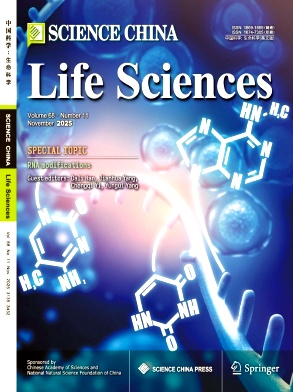
2、刊内网址(202511期):
http://life.scichina.com自动跳转至:
https://www.sciengine.com/SCLS/home
http://www.springer.com/11427
http://link.springer.com/journal/11427
3、投稿系统:
https://mc03.manuscriptcentral.com/scls
4、刊内邮箱:life@scichina.org
官网邮箱:life@scichina.com
(更多编辑邮箱详见官网信息)
5、刊内电话:010-64015399
6、出刊日期:月刊,每月5日出版。
2025年12月10日星期三
Submission Guidelines
【官网信息】
Submit online
Please
visit life.scichina.com, click “Submission & Review”, and use
ScholarOne Manuscript System to submit a manuscript. For a new user,
please create an account and submit a manuscript following the guidance.
Authors
should also submit such accompanying materials as a short statement on
the research background, area/subarea and significance of the work, a
brief introduction to the first and corresponding authors including
their mailing addresses, post codes, telephone numbers, fax numbers, and
email addresses. Authors may suggest several referees (please supply
full names, addresses, phone numbers, fax and emails), and/or request
the exclusion of specific reviewers.
Ethical responsibilities of authors
This
journal is committed to upholding the integrity of the scientific
record. As a member of the Committee on Publication Ethics (COPE) the
journal will follow the COPE guidelines on how to deal with potential
acts of misconduct.
should refrain from misrepresenting research results which could damage
the trust in the journal and ultimately the entire scientific endeavor.
Maintaining integrity of the research and its presentation can be
achieved by following the rules of good scientific practice, which
includes:
·The manuscript has not been submitted to more than one journal for simultaneous consideration.
·The
manuscript has not been published previously (partly or in full),
unless the new work concerns an expansion of previous work (please
provide transparency on the re-use of material to avoid the hint of
text-recycling (“self-plagiarism”)).
·A
single study is not split up into several parts to increase the
quantity of submissions and submitted to various journals or to one
journal over time (e.g., “salami-publishing”).
·No data have been fabricated or manipulated (including images) to support your conclusions
·No
data, text, or theories by others are presented as if they were the
authors own (“plagiarism”). Proper acknowledgements to other works must
be given (this includes material that is closely copied (near verbatim),
summarized and/or paraphrased), quotation marks are used for verbatim
copying of material, and permissions are secured for material that is
copyrighted.
·Important note: the journal may use software to screen for plagiarism.
·Consent
to submit has been received from all co-authors and responsible
authorities at the institute/organization where the work has been
carried out before the work is submitted.
·Authors
whose names appear on the submission have contributed sufficiently to
the scientific work and therefore share collective responsibility and
accountability for the results.
In addition:
·Changes of authorship or in the order of authors are not accepted after acceptance of a manuscript.
·Requests
to add or delete authors at revision stage or after publication is a
serious matter, and may be considered only after receipt of written
approval from all authors and detailed explanation about the
role/deletion of the new/deleted author. The decision on accepting the
change rests with the Editor-in-Chief of the journal.
·Upon
request authors should be prepared to send relevant documentation or
data in order to verify the validity of the results. This could be in
the form of raw data, samples, records, etc.
If there is a suspicion of misconduct, the journal will carry out an investigation following the COPE guidelines. If,
after investigation, the allegation seems to raise valid concerns, the
accused author will be contacted and given an opportunity to address the
issue. If misconduct has been proven, this may result in the
Editor-in-Chief’s implementation of the following measures, including,
but not limited to:
·If the article is still under consideration, it may be rejected and returned to the author.
·If
the article has already been published online, depending on the nature
and severity of the infraction, either an erratum will be placed with
the article or in severe cases complete retraction of the article will
occur. The reason must be given in the published erratum or retraction
note.
·The author’s institution may be informed.
Copyright
A
completed form assigning copyright to Science China Press must be
returned to the editorial office when the paper is accepted for
publication. The copyright covers the exclusive right to reproduce and
distribute the article (in various languages), including reprints,
translations, photographic reproductions, microform, electronic form
(offline, online) or other reproductions of similar nature. The
Copyright Transfer Statement is available at www.life.scichina.com.
Authorship
should be limited to those who have contributed substantially to the
work. Submission of a manuscript is taken to imply that all the named
authors are aware that they are listed as co-authors, and they have seen
and agreed to the submitted version. The corresponding author is the
one who should take the major responsibility to ensure that the
submitted manuscripts are properly prepared in all aspects.
Disclosure of potential conflict of interests
must disclose all relationships or interests that could influence or
bias the work. Although an author may not feel there are conflicts,
disclosure of relationships and interests affords a more transparent
process, leading to an accurate and objective assessment of the work.
Awareness of real or perceived conflicts of interests is a perspective
to which the readers are entitled and is not meant to imply that a
financial relationship with an organization that sponsored the research
or compensation for consultancy work is inappropriate. Examples of
potential conflicts of interests that are directly or indirectly related
to the research may include but are not limited to the following:
·Research grants from funding agencies (please give the research funder and the grant number)
·Honoraria for speaking at symposia
·Financial support for attending symposia
·Financial support for educational programs
·Employment or consultation
·Support from a project sponsor
·Position on advisory board or board of directors or other type of management relationships
·Multiple affiliations
·Financial relationships, for example equity ownership or investment interest
·Intellectual property rights (e.g., patents, copyrights and royalties from such rights)
·Holdings of spouse and/or children that may have financial interest in the work
In
addition, interests that go beyond financial interests and compensation
(non-financial interests) that may be important to readers should be
disclosed. These may include but are not limited to personal
relationships or competing interests directly or indirectly tied to this
research, or professional interests or personal beliefs that may
influence your research.
The
corresponding author will include a summary statement in the text of
the manuscript in a separate section before the acknowledgements.
See below examples of disclosures:
Funding: This study was funded by X (grant number X).
Conflict
of Interest: Author A has received research grants from Company A.
Author B has received a speaker honorarium from Company X and owns stock
in Company Y. Author C is a member of committee Z.
If no conflict exists, the authors should state:
Conflict of Interest: The authors declare that they have no conflict of interest.
Informed consent
All
individuals have individual rights that are not to be infringed.
Individual participants in studies e.g. have the right to decide what
happens to the (identifiable) personal data gathered and to what they
have said e.g. during a study or an interview as well as to any
photograph that was taken. Hence it is important that all participants
gave their informed consent in writing prior to inclusion in the study.
Identifying details (names, dates of birth, identity numbers and other
information) of the participants that were studied should not be
published in written descriptions, photographs, and genetic profiles
unless the information is essential for scientific purposes and the
participant (or parent or guardian if the participant is incapable) has
given written informed consent for publication. Complete anonymity is
difficult to achieve in some cases, and informed consent should be
obtained if there is any doubt. For example, masking the eye region in
photographs of participants is inadequate protection of anonymity. If
identifying characteristics are altered to protect anonymity, such as in
genetic profiles, authors should provide assurance that alterations do
not distort scientific meaning.
The following statement should be included:
Informed consent: “Informed consent was obtained from all individual participants included in the study.”
If identifying information about participants is available in the article, the following statement should be included:
“Additional
informed consent was obtained from all individual participants for whom
identifying information is included in this article.”
Statement of Human and Animal Rights
When
reporting studies that involve human participants, authors should
include a statement that the studies have been approved by the
appropriate institutional and/or national research ethics committee and
have been performed in accordance with the ethical standards as laid
down in the 1964 Declaration of Helsinki and its later amendments or
comparable ethical standards.
If
doubt exists whether the research was conducted in accordance with the
1964 Helsinki Declaration or comparable standards, the authors must
explain the reasons for their approach, and demonstrate that the
independent ethics committee or institutional review board explicitly
approved the doubtful aspects of the study.
The following statements should be included in the text before the References section:
Ethical
approval: “All procedures performed in studies involving human
participants were in accordance with the ethical standards of the
institutional and/or national research committee and with the 1964
Helsinki declaration and its later amendments or comparable ethical
standards.”
welfare of animals used for research must be respected. When reporting
experiments on animals, authors should indicate whether the
institutional and/or national guidelines for the care and use of animals
were followed.
For studies with animals, the following statement should be included:
“All applicable institutional and/or national guidelines for the care and use of animals were followed.”
articles do not contain studies with human participants or animals by
any of the authors, Springer recommends including the following
sentence:
“This article does not contain any studies with human participants or animals performed by any of the authors.”
For retrospective studies, please add the following sentence:
“For this type of study formal consent is not required.”
......
更多详见:
https://www.sciengine.com/SCLS/authorCenter?scroll=section_1