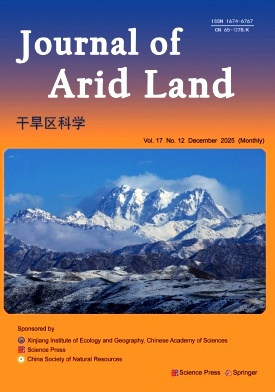
高频栏目
中频栏目
审稿时间:暂无参考数据,审稿时间不确定!
见刊周期:-
温馨提示:以上只是参考信息,实际情况会根据投稿主题、稿件质量和数量、审稿流程有所差异。想获得更准确信息请联系期刊的编辑部进行咨询。
1、投稿方式:在线投稿。
2、刊内网址(202512期):
http://jal.xjegi.com
https://mc03.manuscriptcentral.com/xjjal(投稿系统)
3、官网网址:
https://www.keaipublishing.com/en/journals/journal-of-arid-land/
4、刊内电话:0991-7827334
5、刊内邮箱:xjjal@ms.xjb.ac.cn
6、出刊日期:月刊,每月月底出版。
7、刊内微信公众号:JAL干旱区科学(JAridLand)
2026年1月28日星期三
Guide for Authors
【官网信息】
Journal announcements
Co-sponsored
by Xinjiang Institute of Ecology and Geography, Chinese Academy of
Sciences, Science Press and China Society of Natural Resources, the
Journal of Arid Land is an international peer-reviewed journal that
explores sustainable development and eco-environmental management and
focuses on the arid and semi-arid lands in Central Asia and the world at
large. The Journal of Arid Land publishes 12 issues annually,
maintaining a consistent monthly schedule.
Aims and scope
Journal
of Arid Land is an international, peer-reviewed journal (ISSN 1674-6767
(print version), 2194-7783 (electronic version); CN 65-1278/K) for the
natural sciences. The journal is sponsored by the Xinjiang Institute of
Ecology and Geography, Chinese Academy of Sciences, Science Press and
China Society of Natural Resources.
of Arid Land publishes original, innovative, and integrative research
in arid and semiarid regions, addressing various aspects in geography,
geology, pedology, hydrology, biology, ecology and meteorology. The
following topics are covered:
(1)
The dynamics of natural resources, including water, soil/land,
organisms and climate and the security and sustainable development of
natural resources, the environment and the ecology, especially for
Central Asia;
(2)
The interactions between the atmosphere, hydrosphere, biosphere, and
lithosphere, and the relationship between these natural processes and
human activities;
(3) Patterns of geography, ecology and environment; ecological improvement and environmental protection;
(4) Regional responses and feedback mechanisms to global change.
The
journal releases 12 issues per year, covering full-length
articles/research articles, review articles, short communications,
editorials and short reviews. Occasional special issues provide in-depth
discussion of contemporary issues. We welcome all original, innovative,
and integrative submissions that make contributions to the theories and
methods related to arid and semi-arid areas.
contents of Volumes 1-4 of Journal of Arid Land published can be found
here (http://jal.xjegi.com/EN/article/showOldVolumnList.do), and the
contents of Volumes 5-17 of Journal of Arid Land published with Springer
can be found here
(https://link.springer.com/journal/40333/volumes-and-issues).
Article types
Article type
Requirements
Research article
Maximum word counts 1,0000
Review article
Maximum word counts 1,2000
Short communication
Word counts 3000-4000
Editorials
Word counts 1500-2500
Short review
Word counts 4000-5000
Peer review
This
journal follows a double anonymized review process. Your submission
will initially be assessed by our editors to determine suitability for
publication in this journal. If your submission is deemed suitable, it
will typically be sent to a minimum of two reviewers for an independent
expert assessment of the scientific quality. The decision as to whether
your article is accepted or rejected will be taken by our editors. This
decision is final.
Our editors are not involved in making decisions about papers which:
· they have written themselves.
· have been written by family members or colleagues.
· relate to products or services in which they have an interest.
Any
such submissions will be subject to the journal's usual procedures and
peer review will be handled independently of the editor involved and
their research group.
1.
All manuscripts are reviewed by the editorial office. Any papers which
fail to meet the basic standards of the journal will be desk-rejected
for reasons like out of scope, ethical conflicts, high similarities,
lack of originality, flaws in research design or methods, etc. The
editorial office will reassign selected papers to the Editor-in-chief.
2.
The Editor-in-chief will invite multiple reviewers to review the paper
or assign an editorial board member to invite reviewers to review this
paper.
3.
After at least two reviewers give their reviews and comments, the
Editor-in-chief (or the assigned Editor) provides feedback to the
authors, based on reviewer comments and his own review comments.
4.
When the author submits the revised manuscript, the assigned editor and
Editor-in-chief will collaborate to make a final decision.
5.
For submissions from the Editor-in-Chief, Associate Editors, Guest
Editor(s), other journal Board members, and authors who have conflicts
of interest with them, we ensure that the paper is handled
confidentially by a different team member.
6.
For submissions to Special Issues; if there are conflicts of interest
between the Guest Editor(s) and authors, the submissions will be handled
by another Editor from the Editorial Board who will manage the peer
review process and make the decision whether to accept or reject the
paper after peer review.
Open Access
is an open access journal: all articles will be immediately and
permanently free for everyone to read and download. To provide open
access, this journal has an open access fee (also known as an article
publishing charge APC) which needs to be paid by the authors or on their
behalf e.g. by their research funder or institution.
Creative Commons Attribution-NonCommercial-NoDerivs (CC BY-NC-ND)
Allows
users to: distribute and copy the article; and include in a collective
work (such as an anthology). These uses are permitted only for
non-commercial purposes, and provided the user: gives appropriate credit
to the author(s) (with a link to the formal publication through the
relevant DOI); provides a link to the license; and does not alter or
modify the article.
If
you need to comply with your funding body policy you can apply for a CC
BY license after your manuscript is accepted for publication.
......
更多详见:
http://jal.xjegi.com/EN/column/column7.shtml