低频栏目
审稿时间:暂无参考数据,审稿时间不确定!
见刊周期:-
温馨提示:以上只是参考信息,实际情况会根据投稿主题、稿件质量和数量、审稿流程有所差异。想获得更准确信息请联系期刊的编辑部进行咨询。
1、投稿方式:在线投稿。
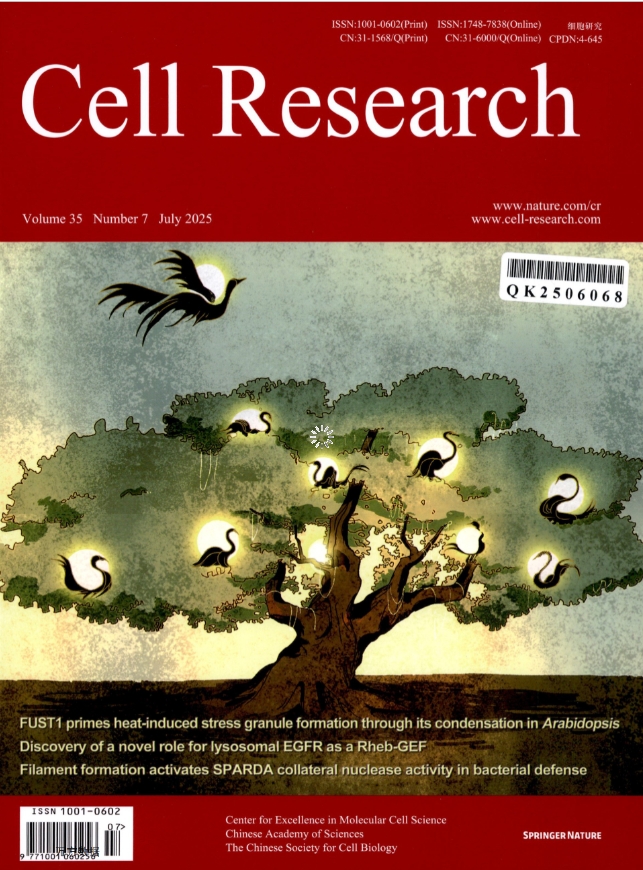
2、刊内网址(202507期):
http://www.cell-research.com/
http://www.nature.com/cr(刊内公布但打不开)
3、官网电话:021-54920953;54922841
4、官网邮箱:
cellres@sibcb.ac.cn;leic@sibcb.ac.cn
5、出刊日期:月刊,一年出版12期。
6、官方微信公众号:Cell Research
2026年2月28日星期六
Guidelines - For Author
【官网信息】
Editorial policy
Submission
to Cell Research implies that all authors have seen and approved the
full manuscript. Corresponding authors of accepted papers will be
required to sign a Licence to Publish form on behalf of all authors (see
below). To avoid unnecessary delays in the review process, please
consider the following policies carefully before submitting your
manuscript.
Duplicate publication
Material
submitted to the journal must be original and not published or
submitted for publication elsewhere in any language. This policy applies
to material submitted elsewhere while the contribution to Cell Research
is under consideration. Authors submitting a manuscript should notify
the editor(s) if part of their contribution has appeared or will appear
elsewhere, or if any related material is under consideration or in press
elsewhere.
If
a submission contains a figure that is published elsewhere or that is
copyrighted, the author must provide documentation that the previous
publisher or copyright holder has given permission for the figure to be
re-published. The editors consider all material in good faith, and
assume that the journal has full permission to publish every part of the
submitted material, including illustrations.
Conflicts of interest
In
the interests of transparency and to help reviewers assess any
potential bias, the journal asks authors of research articles to declare
any competing commercial interests in relation to the submitted work.
Referees are also asked to indicate any potential conflict they might
have with reviewing a particular paper.
Electronic manipulation of images
Digital
image enhancement is acceptable practice, although it can result in the
presentation of unrepresentative data as well as in the loss of
meaningful signals. During manipulation of images a positive
relationship between the original data and the resulting electronic
image must be maintained. If a figure has been subjected to significant
electronic manipulation, the specific nature Guidelines for Authors of
the enhancements must be noted in the figure legend or in the ‘Materials
and methods’ section. The editors reserve the right to request original
versions of figures from the authors of a paper under consideration.
Ethical considerations
Protocols
for research projects involving human subjects or animals must have
been approved by a suitably constituted Ethics Committee of the
institution within which the work was undertaken and must conform to the
provisions of the Declaration of Helsinki (as revised in Edinburgh
2000). Any experiments involving animals must be demonstrated to be
ethically acceptable and, where relevant, conform to national guidelines
for animal usage in research.
Supplementary information for editors and reviewers
Any
manuscripts under review or accepted for publication elsewhere should
accompany the submission if they are relevant to its scientific
assessment. Authors should also provide upon submission any kind of
supplementary material that will aid the review process.
Format of Papers
Preparation of manuscripts
The
manuscript should be double-spaced throughout using 15px Times New
Roman/Arial. Number all pages, beginning from title page, and followed
by abstract, introduction, results, discussion, materials and methods,
acknowledgments, references, figure legends and figures/tables. Gene
symbols should be italicized; protein products are not italicized.
Non-standard abbreviations should be defined in brackets when first used
in the text.
Title
page: The title page should include: full title (a brief declarative
statement of the major findings of the research), running title (no more
than 60 characters including spaces), name of each author, affiliation,
city with postal code and corresponding author’s contact information.
Abstract:
The abstract should briefly (no more than 250 words) describe in
complete sentences the scope of the investigation, the results obtained
and the major conclusions. Abbreviations and reference citations should
be avoided. 3-7 keywords should be given after the abstract.
Introduction:
The introduction should give a brief background knowledge related to
the research and should be as concise as possible.
Results: The results should clearly describe the experimental data in tables and figures.
Discussion: The discussion should focus on the interpretation and significance of the findings with concise objective comments.
Materials and Methods: The materials and methods should be described clearly and referenced in sufficient detail.
Acknowledgments: The acknowledgments should be brief and include financial supports along with the numbers of grants.
Gene
nomenclature: Authors should use approved nomenclature for gene
symbols, and use symbols rather than italicized full names (Ttn, not
titin). Please consult the appropriate nomenclature databases for
correct gene names and symbols. For proposed gene names that are not
already approved, please submit the gene symbols to the appropriate
nomenclature committees as soon as possible, as these must be deposited
and approved before publication of an article.
References
references should include only articles that are published or in press.
The references are each numbered, ordered sequentially as they appear
in the text. List all authors unless there are more than 6, in which
case only the first 3 should be given, followed by “et al”.
Please use the following style for references:
Article in a Journal:
1 Zarubin T, Han JH. Activation and signaling of the p38 MAP kinase pathway. Cell Res 2005; 15:11-18. Chapter in a Book:
2
Hirsimaki P, Arstuka AU, Trump BF, Marzella L. Autophagocytosis. In:
Trump BF, Arstuka AU, eds. Pathobiology of cell membranes. New York:
Plenum Press, 1983:201-236.
A book:
3 Kryger M, Roth T, Dement W, eds. The Principles and Practice of Sleep Medicine. 2nd Edition. Philadelphia: WB Saunders, 1994.
Online Publication:
4
Jelinic P, Stehle JC, Shaw P. The testis-specific factor CTCFL
cooperates with the protein methyltransferase PRMT7 in H19 imprinting
control region methylation. PLoS Biol 2006; 4: e355.
DOI: 10.1371/journal.pbio.0040355
......
更多详见:
http://www.cell-research.com/Guidelines%20-%20For%20Author.php