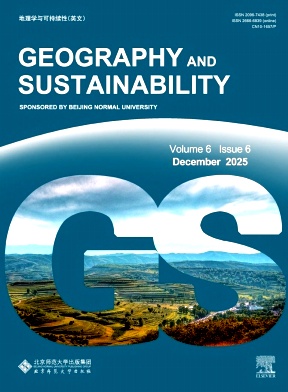
and Sustainability aims to serve as the focal point for developing,
coordinating and implementing interdisciplinary research and education
to promote sustainable development through an integrated geography
perspective. The journal encourages wider analysis and innovative
thinking about global and regional sustainability by bridging and
synthesising natural and human sciences.
Geography
and Sustainability welcomes original, high-quality research articles,
review articles, short communications, technical comments, perspective
articles and editorials on the following themes:
Geographical
Processes: Interactions with and between water, soil, atmosphere and
the biosphere and their spatio-temporal variations;
Human-Environmental
Systems: Interactions between humans and the environment, resilience of
socio-ecological systems and vulnerability;
Ecosystem Services and Human Wellbeing: Ecosystem structure, processes, services and their linkages with human wellbeing;
Sustainable Development: Theory, practice and critical challenges in sustainable development;
Geo-data and Sustainability Models: Geodata and models to support sustainable development and decision-making
Article types
Contributions
falling into the following categories will be considered for
publication: Full length article or original research paper (please find
a template here), review article, short communication, comment,
perspective and editorial. Please ensure that you select the appropriate
article type from the list of options when making your submission.
Authors contributing to special issues should ensure that they select
the special issue article type from this list.
Types of Articles instruction
1.
Full Length Article: A full-length article should be a substantial and
in-depth research study regarding a particular state of issue through
several techniques or approaches. The main text should be approximately
6,000 words in length, but it should not exceed 8,000 words (excluding
abstract, references, tables, figures, and appendices). A 250-word
abstract, a maximum of 80 references and up to 10 displayed items
(figures and tables) are allowed. A full-length article should include
Introduction, Materials and methods, Results, Discussion, Conclusions,
and References, which can be accompanied by Supplementary information.
The sections of Materials and methods, Results, and Discussion should be
divided by numbered topical subheadings.
2.
Review Article: A review article should provide recent developments in
scientific disciplines, including historical overviews, recent
scientific advances, and perspectives for future development. It should
be critical, balanced, and scholarly. The main text should be
approximately 6,000 words in length, but it should not exceed 8,000
words (excluding abstract, references, tables, figures, and appendices).
A 250-word abstract, a maximum of 100 references and up to 10 displayed
items (figures and tables) are allowed. A review article can be
accompanied by supplementary information.
3.
Short Communication: A short communication provides a brief study of
high quality and general interest. It should be published quickly. A
short communication is expected to be approximately 3000 words with up
to 4 displayed items, a 250-word abstract, and a maximum of 20
references. Short Communications can be accompanied by supplementary
information.
4.
Editorials: Editorials are written by the Editor-in-Chief, Associate
Editors, Guest Editors, Editorial Board Members, or invited scientists
and experts. Editorials are not typically peer-reviewed articles with
less than 3,000 words in main text, up to 20 references, and no more
than 2 displayed items (tables and figures).
5.
Perspectives: Perspectives present a new and unique viewpoint on
existing problems, fundamental concepts, or prevalent notions on a
specific topic, propose and support a new hypothesis, or discuss the
implications of a newly implemented innovation. Perspectives focus on
current advances and future directions on a topic with personal opinion,
and may include original data. Compared to Reviews, they are more
forward looking and speculative with a narrower field of view.
Perspectives are usually short peer-reviewed articles less than 5,000
words in main text, a 250-word abstract, no more than 50 references, and
up to 6 displayed items (figures and tables). Perspectives can be
accompanied by Supplementary information.
6.
Comment: Comments are opinionated articles on a topical scientific
issue, a relevant policy or a newly published article in the journal.
Comments are suggested to develop a proposed solution in detail while
focusing on an issue or problem. For comments on a recent publication,
they can either challenge or extend one or more aspects of a focal
article with a respective and constructive tone. A comment is generally
with a short length of approximately 2,000 words in main text and 15
references. It is encouraged to provide 1 figure or table, but not
prerequisite.
7.
Highlight: Highlights aim to highlight and explain potential scientific
importance of a most recent exciting research work. Highlights should
be approximately 1,500 words in main text, up to 1 displayed items
(figures and tables) and 10 references.
8.
Letter to the editor: Letter to the editor is for scientific comments
on recently published articles or discusses an important, novel research
result. Letters are usually not divided by section headings, and are
generally approximately 1,000 words including introductory paragraph,
main content, conclusions, up to 5 references, author names and
affiliations.
9.
Book Review: A book review provides a personally critical appraisal of a
book by evaluating such aspects as theme and argument, organization and
writing style, scientific significance, etc. Book reviews are invited
submissions or approved submissions by the editor and unsolicited
contributions are not accepted. Book reviews in Geography and
Sustainability address the topics in the cross-disciplinary field of
integrated geography and sustainability science. Book reviews are
generally short articles with approximately 1,000 words and up to 10
references.
10.
News and Views: New and views articles inform readers about new
scientific advances or important events in the field of integrated
geography and sustainability science. This is a commission-only section.
The length of the article generally should not exceed 1000 words with
less than 5 references.
Peer review
This
journal follows a double anonymized review process. Your submission
will initially be assessed by our editors to determine suitability for
publication in this journal. If your submission is deemed suitable, it
will typically be sent to a minimum of two reviewers for an independent
expert assessment of the scientific quality. The decision as to whether
your article is accepted or rejected will be taken by our editors.
Read more about peer review.
Our editors are not involved in making decisions about papers which:
they have written themselves.
have been written by family members or colleagues.
relate to products or services in which they have an interest.
Any
such submissions will be subject to the journal's usual procedures and
peer review will be handled independently of the editor involved and
their research group. Read more about editor duties.
Authors
may submit a formal appeal request to the editorial decision, provided
it meets all the requirements and follows the procedure outlined in
Elsevier’s Appeal Policy. Only one appeal per submission will be
considered and the appeal decision will be final.
Special issues and article collections
The
peer review process for special issues and article collections follows
the same process as outlined above for regular submissions, except, a
guest editor may send the submissions out to the reviewers and may
recommend a decision to the journal editor. The journal editor oversees
the peer review process of all special issues and article collections to
ensure the high standards of publishing ethics and responsiveness are
respected and is responsible for the final decision regarding acceptance
or rejection of articles.
Open access
We refer you to our open access information page to learn about open access options for this journal.
Ethics and policies
Ethics in publishing
Authors must follow ethical guidelines stated in Elsevier's Publishing Ethics Policy.
Submission declaration
When authors submit an article to an Elsevier journal it is implied that:
the
work described has not been published previously except in the form of a
preprint, an abstract, a published lecture, academic thesis or
registered report. See our policy on multiple, redundant or concurrent
publication.
the article is not under consideration for publication elsewhere.
the
article's publication is approved by all authors and tacitly or
explicitly by the responsible authorities where the work was carried
out.
if
accepted, the article will not be published elsewhere in the same form,
in English or in any other language, including electronically, without
the written consent of the copyright-holder.
To verify compliance with our journal publishing policies, we may check your manuscript with our screening tools.
Authorship
All authors should have made substantial contributions to all of the following:
The conception and design of the study, or acquisition of data, or analysis and interpretation of data.
Drafting the article or revising it critically for important intellectual content.
Final approval of the version to be submitted.
Authors
should appoint a corresponding author to communicate with the journal
during the editorial process. All authors should agree to be accountable
for all aspects of the work to ensure that the questions related to the
accuracy or integrity of any part of the work are appropriately
investigated and resolved.
Changes to authorship
The
editors of this journal generally will not consider changes to
authorship once a manuscript has been submitted. It is important that
authors carefully consider the authorship list and order of authors and
provide a definitive author list at submission.
The policy of this journal around authorship changes:
All
authors must be listed in the manuscript and their details entered into
the submission system. Changes can only be made prior to acceptance,
and only if approved by the journal editor. This includes additions,
deletion, or rearrangement of author names.
Requests
to change authorship must be made by the corresponding author using
this form. The corresponding author must provide the reason for the
request to the journal editor with written confirmation from all
authors, including any authors being added or removed, that they agree
with the changes. Requests which do not comply with the instructions
outlined in the form will not be considered.
This
journal does not allow authorship changes after acceptance. This
includes additions, deletions, or the rearrangement of author names,
including changes to the corresponding author.
The review process may be paused while a change in authorship request is being considered.
Approved authorship changes will result in a corrigendum if the manuscript has already been accepted.
Any
unauthorized authorship changes may result in the rejection of the
manuscript or retraction if the article has already been published.
Declaration of competing interests
All
authors must disclose any financial and personal relationships with
other people or organizations that could inappropriately influence or
bias their work. Examples of potential competing interests include:
Employment
Consultancies
Stock ownership
Honoraria
Paid expert testimony
Patent applications or registrations
Grants or any other funding
Affiliation with the journal as an Editor or Advisory Board Member
The declarations tool should always be completed.
Authors with a journal affiliation to declare should enter the following text under “Other Activities” within the declarations tool and should inform the journal and publisher prior to completing the submission process:
Given
their role as [insert journal role title], [insert your name] had no
involvement in the peer-review of this article and has no access to
information regarding its peer-review. Full responsibility for the editorial process for this article was delegated to another journal editor.
Editorial
disclosure statements will be included as a footnote and/or in the
declaration of competing interest section of the article.
Authors with no competing interests to declare should select the option "I have nothing to declare".
The
resulting Word document containing your declaration should be uploaded
at the "attach/upload files" step in the submission process. It is
important that the Word document is saved in the .doc/.docx file format.
Author signatures are not required.
Funding sources
Authors
must disclose any funding sources who provided financial support for
the conduct of the research and/or preparation of the article. The role
of sponsors, if any, should be declared in relation to the study design,
collection, analysis and interpretation of data, writing of the report
and decision to submit the article for publication. If funding sources
had no such involvement this should be stated in your submission.