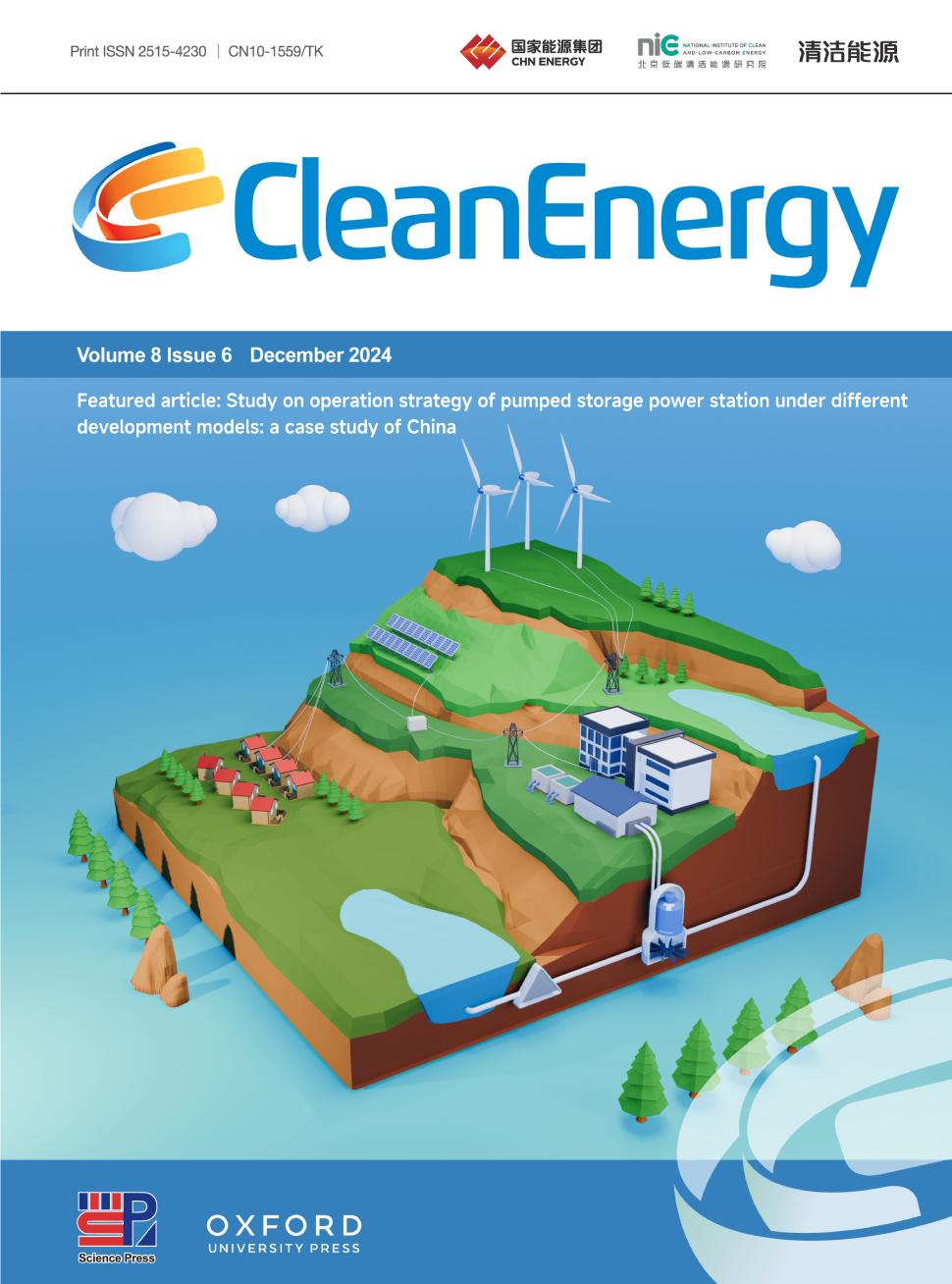
Clean Energy is an open access, peer-reviewed international journal, and serves as an important medium to present the latest research developments and knowledge on topics related to clean energy. The Journal will provide a high-profile platform for scientists, academic researchers, engineers and industrial professionals to publish papers of the highest quality and significance related to technologies for clean and low-carbon energy generation.
We are interested in:
Research articles (8,000 words maximum, up to 8 figures)
Review articles (10,000 words maximum, up to 8 figures)
Engineering Practice (6,000 words maximum, up to 6 figures)
Perspectives (2,000-4,000 words, up to 5 figures)
Insight (2,000-4,000 words, up to 5 figures)
Clean Energy also accepts Editorials, News and focus articles, and Research Centre Profiles, which are not peer-reviewed.
Research areas covered in the journal include:
Carbon neutrality: Reducing GHG emissions from the industrial and utility sectors by carbon capture, utilization and storage (CCUS); reducing atmospheric CO2 via direct air capture (DAC).
Renewable energy: Clean energy from non-fossil fuel sources, including: solar energy; wind energy; hydro and wave energy; hydrogen and fuel cells; biomass energy and biofuels.
Innovative energy generation and use: Technologies that advance clean and low-carbon energy, including advanced clean coal technologies (CCT); hybrid energy generation systems, for example, combining thermal power generation and concentrated solar power, combined heat and power systems.
Fundamental chemistry and materials science to support clean energy: Fundamental advances in chemical processes or materials for generating and storing clean energy.
Energy storage and conversion: Systems or devices for storing and dispatching energy, including batteries, ultracapacitors, fuel cells, compressed air storage, thermal energy storage and generation, hydro energy storage, kinetic energy storage.
NOTE: Clean Energy publishes original research that advances the state-of-the-art using detailed experimental or modeling methods that are transparent and based on fundamental principles. Clean Energy no longer accepts modeling papers using design platforms such as HOMER, PVsyst, RETScreen, etc. as the primary method of analysis. Clean Energy no longer accepts case studies, which means application of a particular technology at a single location, because such works do not present probable interest to a general clean energy readership.