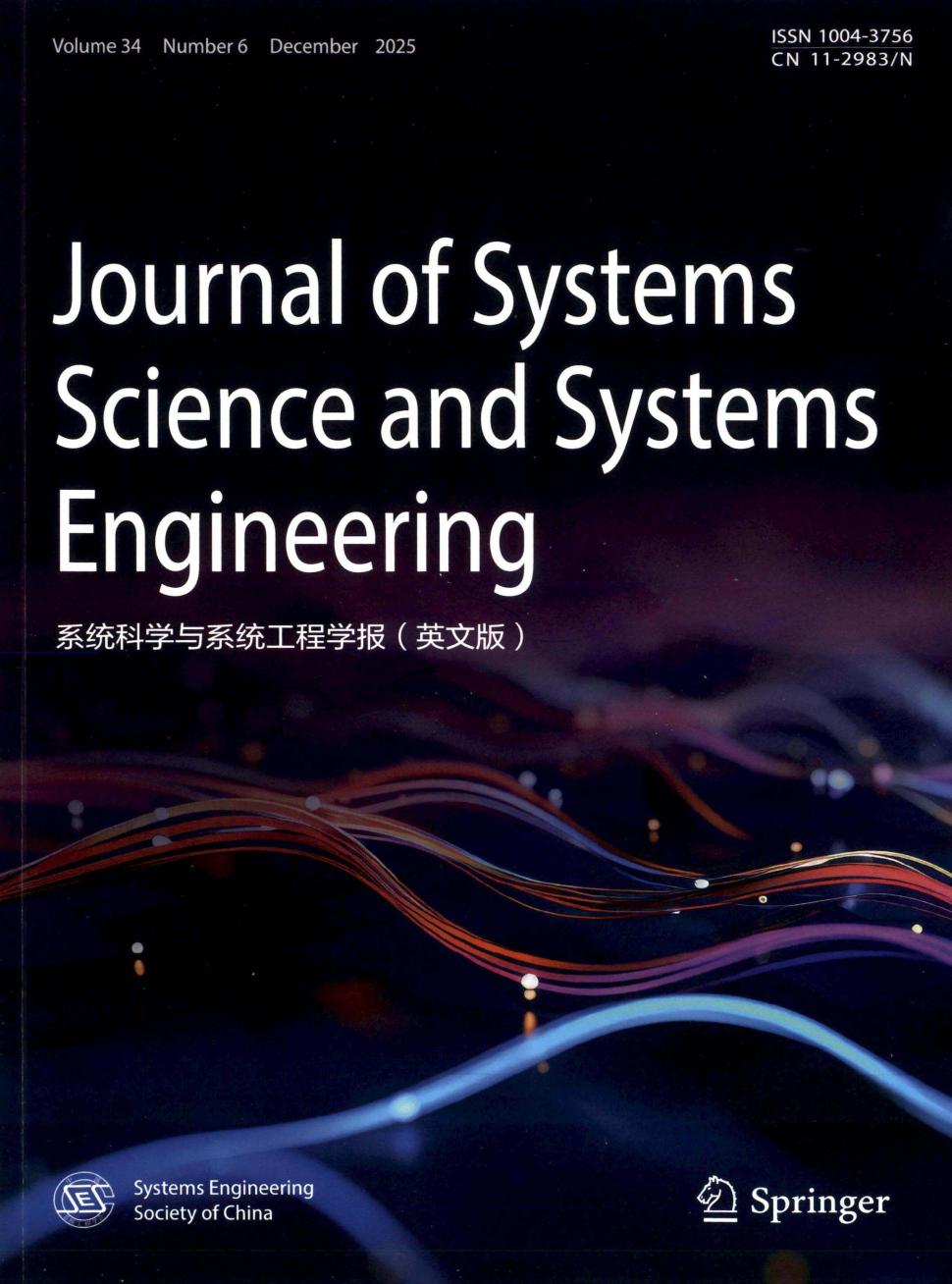
低频栏目
审稿时间:暂无参考数据,审稿时间不确定!
见刊周期:-
温馨提示:以上只是参考信息,实际情况会根据投稿主题、稿件质量和数量、审稿流程有所差异。想获得更准确信息请联系期刊的编辑部进行咨询。
1、投稿方式:在线投稿。
2、刊内网址(202506期):
http://www.rccm.tsinghua.edu.cn/jssse/Overview.htm
3、期刊英文主页:
https://link.springer.com/journal/11518
4、投稿系统:
https://www.editorialmanager.com/jsys
5、刊内邮箱:jssse@mail.tsinghua.edu.cn
6、刊内电话:010-62789928
7、出刊日期:双月刊,逢双月出版。
2026年2月12日星期四
Submission guidelines
【官网信息】
Instructions for Authors
Types of Papers
The Journal of Systems Science and Systems Engineering publishes the following types of papers:
• Research Papers: Original research papers subdivided into section (Introduction, Methods, Results, Discussion, and Conclusion).
• Reviews: Reviews by experts in the field are invited.
• Technical Notes: Short scientific notes. Abstract and conclusion are compulsory.
Back to top
Editorial procedure
Double-blind peer review
This
journal follows a double-blind reviewing procedure. This means that the
author will remain anonymous to the reviewers throughout peer review.
It is the responsibility of the author to anonymize the manuscript and
any associated materials.
Author
names, affiliations and any other potentially identifying information
should be removed from the manuscript text and any accompanying files
(such as figures of supplementary material);
A
separate Title Page should be submitted, containing title, author
names, affiliations, and the contact information of the corresponding
author. Any acknowledgements, disclosures, or funding information should
also be included on this page;
Authors should avoid citing their own work in a way that could reveal their identity.
journal also publishes special/guest-edited issues. The peer review
process for these articles is the same as the peer review process of the
journal in general.
Additionally, if a guest editor authors an article in their issue/collection, they will not handle the peer review process.
Manuscript Submission
Submission
of a manuscript implies: that the work described has not been published
before; that it is not under consideration for publication anywhere
else; that its publication has been approved by all co-authors, if any,
as well as by the responsible authorities – tacitly or explicitly – at
the institute where the work has been carried out. The publisher will
not be held legally responsible should there be any claims for
compensation.
Permissions
Authors
wishing to include figures, tables, or text passages that have already
been published elsewhere are required to obtain permission from the
copyright owner(s) for both the print and online format and to include
evidence that such permission has been granted when submitting their
papers. Any material received without such evidence will be assumed to
originate from the authors.
How to Submit
Manuscripts
should preferably be submitted in the original file format. Please
follow the hyperlink “Submit manuscript” on the right to open an e-mail
to the editor and attach the files.
Please
ensure you provide all relevant editable source files. Failing to
submit these source files might cause unnecessary delays in the review
and production process.
Title Page
Please make sure your title page contains the following information.
Title
The title should be concise and informative.
Author information
The name(s) of the author(s)
The affiliation(s) of the author(s), i.e. institution, (department), city, (state), country
A clear indication and an active e-mail address of the corresponding author
If available, the 16-digit ORCID of the author(s)
If address information is provided with the affiliation(s) it will also be published.
For
authors that are (temporarily) unaffiliated we will only capture their
city and country of residence, not their e-mail address unless
specifically requested.
Large
Language Models (LLMs), such as ChatGPT, do not currently satisfy our
authorship criteria. Notably an attribution of authorship carries with
it accountability for the work, which cannot be effectively applied to
LLMs. Use of an LLM should be properly documented in the Methods section
(and if a Methods section is not available, in a suitable alternative
part) of the manuscript. The use of an LLM (or other AI-tool) for "AI
assisted copy editing" purposes does not need to be declared. In this
context, we define the term "AI assisted copy editing" as AI-assisted
improvements to human-generated texts for readability and style, and to
ensure that the texts are free of errors in grammar, spelling,
punctuation and tone. These AI-assisted improvements may include wording
and formatting changes to the texts, but do not include generative
editorial work and autonomous content creation. In all cases, there must
be human accountability for the final version of the text and agreement
from the authors that the edits reflect their original work.
Abstract
provide an abstract of 150 to 250 words. The abstract should not
contain any undefined abbreviations or unspecified references.
For life science journals only (when applicable)
Trial registration number and date of registration for prospectively registered trials
Trial
registration number and date of registration, followed by
“retrospectively registered”, for retrospectively registered trials
Keywords
Please provide 4 to 6 keywords which can be used for indexing purposes.
Statements and Declarations
The
following statements should be included under the heading "Statements
and Declarations" for inclusion in the published paper. Please note that
submissions that do not include relevant declarations will be returned
as incomplete.
Competing
Interests: Authors are required to disclose financial or non-financial
interests that are directly or indirectly related to the work submitted
for publication. Please refer to “Competing Interests and Funding” below
for more information on how to complete this section.
......
更多详见:
https://link.springer.com/journal/11518/submission-guidelines