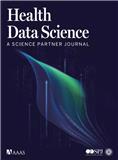
近日,国家新闻出版署下达批复,同意《健康数据科学(英文)》(Health Data Science)公开发行,国内统一连续出版物号为CN10-1749/R。期刊将采用跨学科分析方法和前沿技术挖掘健康医疗数据的价值,提高数据质量和数据使用伦理标准,打造健康数据科学交流与发展平台,服务医学临床实践、研究与决策。
Health Data Science是北京大学主办、北京大学健康医疗大数据国家研究院承办、北京大学信息技术高等研究院 (浙江)协办的开放获取英文期刊,已于2020年7月入选“中国科技期刊卓越行动计划”高起点新刊项目。
《健康数据科学(英文)》作者须知
【官网信息】
For Authors
To check on the status of your submission, please visit the Health Data Science manuscript submission site.
For
general guidance on using the manuscript submission system, please read
the tutorials for Authors, Editors, and Reviewers. For questions on
specific functionality, explore the Editorial Manager video library.
Categories of Manuscripts
The
journal Health Data Science accepts submissions for original research
articles, review articles, editorials, perspectives (by invitation) and
letters to the Editor.
Prior
to submission, each author should review and be prepared to fulfill the
submission requirements outlined on the Publication Ethics page and
comply with the following limitations.
Research
articles should present a major advance and must include an abstract of
up to 250 words, an introduction and sections with brief and
informative subheadings. Authors may include up to ten figures and/or
tables and about 50 references. The total research article length
usually should be under 5,000 words. Supplementary materials should be
limited to information that is not essential for the general
understanding of the research presented in the main text and can include
data sets, figures, tables, videos or audio files. For ease in
preparing your submission, please follow the manuscript templates in
Word and LaTex.
Review
articles should describe and synthesize recent developments of
interdisciplinary significance and highlight future directions. Reviews
must include an abstract with a structure outlining the importance,
highlights and conclusion. The article must contain an introduction
outlining the main theme, brief subheadings and an outline of important
unresolved questions. Reviews should be no longer than 5,000 words,
although longer manuscripts will be considered. Authors may include up
to six figures and/or tables and up to 100 references. Most reviews are
solicited by the editors. Unsolicited submissions will be considered,
but authors are encouraged to contact the Editors first before writing a
review paper.
Editorials
are short opinion pieces that discuss an issue of immediate importance
to the health data science community. Editorials should have fewer than
1,000 words total, no abstract, a minimal number of references (no more
than 20) and no figures or tables. Editorials are usually solicited by
the editors. If authors have suggestions for an Editorial, they should
contact the editorial office first before submitting a paper.
In
principle, Perspectives are invitation-only papers that highlight
recent exciting thoughts, research and important issues in health data
science, with data and facts properly cited. These papers should not
contain unpublished findings or primarily discuss the author’s own work.
They may provide context for the findings within a field or explain
potential interdisciplinary importance. As these are meant to express a
personal viewpoint, with rare exceptions, Perspectives should have no
more than three authors. Perspectives should not include an abstract,
have no more than 1,000 words, can include up to two figures or tables,
and have less than 10 references. If interested in submitting a
Perspective, please contact hds@hsc.pku.edu.cn to provide a summary of
your topic and request an invitation to submit; the Editorial team will
evaluate your request and extend an invitation if appropriate.
Letters
to the Editor are letters responding to articles published in Health
Data Science. These Letters should add a dimension to the research
(constructive response or critique) and not merely be a summary of the
paper. Letters should have no more than 400 words with a maximum of five
references; usually no table or figure is needed (if necessary, up to
one table or figure is acceptable).
Preparation of Manuscripts
English Language Editing Services
Interested
in English language assistance prior to submission? The Science Partner
Journals publishing team has evaluated the work of the companies listed
on the SPJ Author Services page and found their services to be
effective for editing scientific English language in manuscripts prior
to submission.
Experimental Design and Statistics Guidelines
Study Design Guidelines
In
the first section of the Materials and Methods, we encourage authors to
have first subtitle of "Experimental and Technical Design," which
includes a diagram or flowchart to show the entire experimental design
and illustrates the most significant elements: materials, treatments,
measurements, data collection, methods of data analysis. This will
facilitate the editors, reviewers and readers to understand and follow
the whole concept, design, and results.
Statistical Analysis Guidelines
Generally, authors should describe statistical methods with enough detail and follow relevant reporting guidelines.
Reporting Guidelines
Authors
are encouraged to follow published standard reporting guidelines for
the study discipline. Many of these guidelines can be found at the
EQUATOR website.
Figure, Table & Supplementary Material Guidelines
Creating Your Figures
It
is best to create your figures as vector-based files such as those
produced by Adobe Illustrator. Vector-based files will give us maximum
flexibility for sizing your figures properly without losing resolution.
These figure files can be saved at a lower resolution to minimize the
file size at initial submission.
Although
we do not need the highest-resolution files for the initial submission,
you will need to have these high-resolution files of your figures on
hand so that they can be submitted with your revised manuscript for
final publication production. Each figure or image must be in a separate
editable file format at revision. Images may be in TIFF, GIF, JPEG,
PNG, BMP, PS, EPS, Word, Excel, PowerPoint, or PDF.
Figure Layout and Scaling
In
laying out information in a figure, the objective is to maximize the
space given to presentation of the data. Avoid wasted white space and
clutter.
Please follow these guidelines for your figures:
The figure’s title should be at the beginning of the figure legend, not within the figure itself.
Include the figure’s identifying number (e.g., "Figure 1") on the same manuscript page that includes the figure.
Keys to symbols, if needed, should be kept as simple as possible. Details can be put into the figure legend.
Use
solid symbols for plotting data if possible (unless data overlap or
there are multiple symbols). For legibility when figures are reduced,
symbol sizes should be a minimum of 6 points and line widths should be a
minimum of 0.5 points.
Panels should be set close to each other and common axis labels should not be repeated.
Scales
or axes should not extend beyond the range of the data plotted. All
microscopic images should include scale bars, with their values shown
either with the bar or in the figure legend. Do not use minor tick marks
in scales or grid lines. Avoid using y-axis labels on the right that
2021年6月16日,由北京大学主办、北京大学健康医疗大数据国家研究院承办、作为Science合作期刊在全球发行、开放获取的全新英文科技期刊Health Data Science(中文名《健康数据科学》)正式刊文。主编北京大学健康医疗大数据国家研究院院长詹启敏院士撰写的创刊社论(Editorial)译文