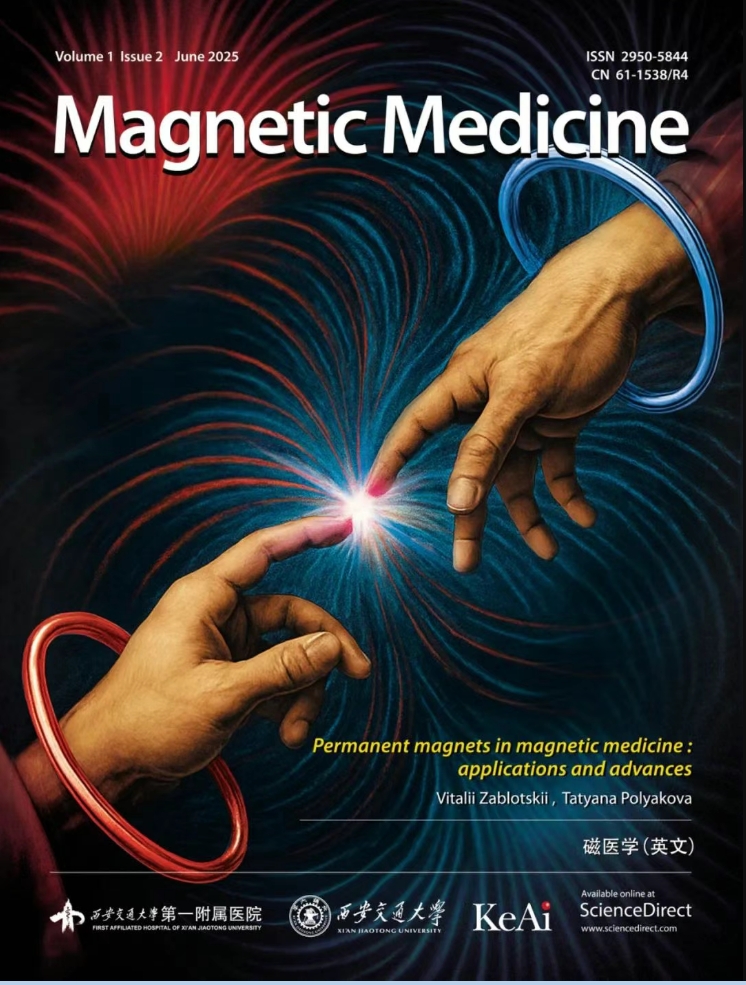
审稿时间:暂无参考数据,审稿时间不确定!
见刊周期:-
温馨提示:以上只是参考信息,实际情况会根据投稿主题、稿件质量和数量、审稿流程有所差异。想获得更准确信息请联系期刊的编辑部进行咨询。
1、投稿方式:在线投稿。
2、官网网址:
https://www.keaipublishing.com/en/journals/magnetic-medicine/
https://www.sciencedirect.com/journal/magnetic-medicine
3、投稿系统:
https://www.editorialmanager.com/magmed
4、官网邮箱:magmed@xjtu.edu.cn
5、官网电话:029-85324467
6、出刊日期:季刊,逢季末月出版。
7、官方微信公众号:Magnetic Medicine 磁医学
8、官网信息:2026年12月31日前投稿免收APC
2025年8月11日星期一
Guide for Authors投稿指南
【官网信息】
Introduction
Types of paper
Full-length/ Research Article (Word limit: 3000-7000)
A complete report on original research and/or clinical studies
A structured abstract is required.
A clear structure is required, which should contain but not confined to the following sections:
Material and methods
Results
Discussion
Conclusions
Authors’ contribution (For details please visit the link.)
Ethic statement
COI
(acknowledgments/clarification)
Bibliography
Appendices (including multimedia components)
Review Article (Word limit: 7000-10000)
A
substantial overview presents a complete overview of the state of the
art with a comprehensive bibliography, generally, also contains a table
of contents. It should cover topics that have seen significant
development or progress in recent years, with comprehensive depth and a
balanced perspective. Review articles should NOT include unpublished
material such as unpublished/original data, submitted manuscripts, or
personal communication.
Mini Review (Word limit: 3000-4000)
succinct and clear summary that covers focused aspects of a current
area of investigation and its recent developments, providing up-to-date
developments, concepts, etc.
Editorial (Word limit: 300-500)
Generally from the (guest) editor of the publication. Can be Foreword, Editorial, Guest Editorial, Preface, etc.
Perspective (Word limit: 3000)
perspective offers a forward-looking view of the intersection between
fields, highlighting emerging trends, potential opportunities, and key
challenges. The content should facilitate comprehensive discussion and
in-depth exploration, supported by flexible citation limits to
accommodate comprehensive discussion.
Commentary (Word limit: 1500)
commentary provides expert insights on recent developments, technical
innovations, or clinical applications in the intersection of magnetic
technologies and biomedical field. Concise, with up to 20 references.
Short Communication
Short
report or announcement of research, usually claiming certain results,
which present original and significant material for rapid dissemination.
Short Communications are expected to have a higher than average impact
on the field rather than report on incremental research.
Guideline/Consensus (Word limit: 3000-8000) (for clinical medicine only)
Guidelines:
documents that have been locally or internationally approved and
contain general principles that may benefit others in their clinical
practice or in writing their own guidelines.
Consensus:
evidence-based analyses of issues that integrate findings, ideas and/or
conceptual frameworks from a variety of sources in a clear and balanced
way.
Case Report (Word limit: 1500)
Case
Reports (CR) are brief reports of individual patients or small cohorts
reporting novel findings of unexpected clinical significance. They are
peer-reviewed articles under xxx words in length. Methods and additional
figures and display items may be included in the Supplementary
Information.
Letter to the Editor (Word limit: 2000)
Any
items of interest to the wide audience of the publication. The items
includes a letter to the editor commenting on previously published
articles or a reply to the letter. (The letter or reply needs a
“refers-to” DOI or PII number; or argumentative communication, like
papers in a discussion, or commentaries, etc.(Subsequent discussion
papers need a “refers-to” DOI or PII number).
Submission checklist
You
can use this list to carry out a final check of your submission before
you send it to the journal for review. Please check the relevant section
in this Guide for Authors for more details.
Ensure that the following items are present:
One author has been designated as the corresponding author with contact details:
E-mail address
Full postal address
All necessary files have been uploaded:
Manuscript
Include keywords
All figures (include relevant captions)
All tables (including titles, description, footnotes)
Ensure all figure and table citations in the text match the files provided
• Indicate clearly if color should be used for any figures in print
Graphical Abstracts / Highlights files (where applicable)
Supplemental files (where applicable)
Further considerations:
Manuscript has been 'spell checked' and 'grammar checked'
All references mentioned in the Reference List are cited in the text, and vice versa
Permission has been obtained for use of copyrighted material from other sources (including the Internet)
A competing interests statement is provided, even if the authors have no competing interests to declare
Journal policies detailed in this guide have been reviewed
For further information, visit our Support Center.
Before you begin
Ethics in publishing
Please
see our information pages on Ethics in publishing and Ethical
guidelines for journal publication. Submissions to KeAi journals are
automatically screened using iThenticate's CrossCheck within the
editorial system to detect plagiarism issues including instances of
overlapping and similar text in submitted manuscripts. Details can be
found here. High similarity papers will be desk rejected.
Ethics approval and consent to participate
Manuscripts reporting studies involving human participants, human data or human tissue must:
include a statement on ethics approval and consent (even where the need for approval was waived)
include the name of the ethics committee that approved the study and the committee's reference number if appropriate
All
materials must adhere to high ethical and animal welfare standards. Any
use of animals must be based on ethological knowledge and respect for
species-specific requirements for health and well-being. A statement
indicating that the protocol and procedures employed were ethically
reviewed and approved, and the name of the body giving approval, must be
included in the Methods section of the manuscript.
Consent for publication:
If
your research or manuscript contains any individual person's data in
any form (including any individual details, images or videos), consent
for publication must be obtained from that person, or in the case of
children, their parent or legal guardian. All presentations of case
reports must have consent for publication.
Studies in humans and animals
the work involves the use of human subjects, the author should ensure
that the work described has been carried out in accordance with The Code
of Ethics of the World Medical Association (Declaration of Helsinki)
for experiments involving humans. The manuscript should be in line with
the Recommendations for the Conduct, Reporting, Editing and Publication
of Scholarly Work in Medical Journals and aim for the inclusion of
representative human populations (sex, age and ethnicity) as per those
recommendations. The terms sex and gender should be used correctly.
The
author should ensure that the manuscript contains a statement that all
procedures were performed in compliance with relevant laws and
institutional guidelines and have been approved by the appropriate
institutional committee(s). This statement should contain the date and
reference number of the ethical approval(s) obtained. Authors should
also include a statement in the manuscript that informed consent was
obtained for experimentation with human subjects. The privacy rights of
human subjects must always be observed.
journal will not accept manuscripts that contain data derived from
unethically sourced organs or tissue, including from executed prisoners
or prisoners of conscience, consistent with recommendations by Global
Rights Compliance on Mitigating Human Rights Risks in Transplantation
Medicine. For all studies that use human organs or tissues authors must
provide sufficient evidence that they were procured in line with WHO
Guiding Principles on Human Cell, Tissue and Organ Transplantation. The
source of the organs or tissues used in clinical research must be
transparent and traceable. Authors of manuscripts describing organ
transplantation must additionally declare within the manuscript:
that autonomous consent free from coercion was obtained from the donor(s) or their next of kin; and
that organs/tissues were not sourced from executed prisoners or prisoners of conscience.
animal experiments should comply with the ARRIVE guidelines and should
be carried out in accordance with the U.K. Animals (Scientific
Procedures) Act, 1986 and associated guidelines, EU Directive 2010/63/EU
for animal experiments, or the National Research Council's Guide for
the Care and Use of Laboratory Animals and the authors should clearly
indicate in the manuscript that such guidelines have been followed. The
sex of animals must be indicated, and where appropriate, the influence
(or association) of sex on the results of the study.
……
更多详情:
https://www.sciencedirect.com/journal/magnetic-medicine/publish/guide-for-authors