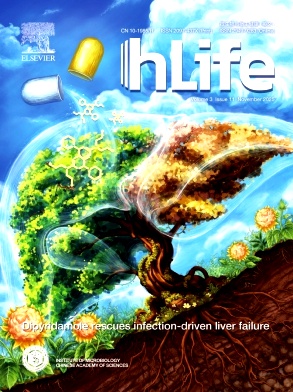
高频栏目
中频栏目
审稿时间:暂无参考数据,审稿时间不确定!
见刊周期:-
温馨提示:以上只是参考信息,实际情况会根据投稿主题、稿件质量和数量、审稿流程有所差异。想获得更准确信息请联系期刊的编辑部进行咨询。
1、投稿方式:在线投稿。
2、官网网址(微信公众号信息):
https://www.sciencedirect.com/journal/hlife
3、投稿系统:
https://www.editorialmanager.com/hlife/default2.aspx
4、主办单位官网:http://www.im.cas.cn/
5、官网邮箱:hlife@im.ac.cn
6、官网电话:010-64807577
7、出刊日期:月刊,一年出版12期。
8、微信公众号信息:2026年前接收的稿件免收文章处理费(APC)
9、官方微信公众号:hLife Journal
2025年12月3日星期三
Guide for authors
【官网信息】
Introduction
Types of article
The
hLife journal publishes full-length original Articles, Reviews,
Perspectives, Letters, Commentaries, Resources, Case reports, News &
Views, Recollections, Histories, Editorials, and Dialogues.
Article:
Original report of a new study in basic, translational, or clinical
medicine. It should be organized in the following order: title page,
graphical abstract, highlights, abstract, keywords, introduction,
results, discussion, materials and methods, acknowledgments, references,
figure legends, figures, and tables. With approximately 6000 words in
the main text (excluding references and figures/tables); no more than
200 words in the abstract; no less than 6 figures/tables.
Review:
Comprehensive and authoritative survey of recent developments and
advances in the research field related to health science topics. With
graphical abstract and highlights, no less than 8000 words in the main
text (excluding references and figures/tables); no more than 200 words
in the abstract; no less than 6 figures/tables.
Perspective:
Review and discuss the primary research literature in which the authors
may express particular points of view about health-related science and
social issues. The length of the main text (main text excluding
references and figures/tables) should not exceed 1500 words; an abstract
is not required; 1 figure/table, and no more than 10 references.
Letter:
Original report of timely new results that are of substantial clinical,
medical, or public health importance. The length of the main text (main
text excluding references and figures/tables) should not exceed 1000
words; an abstract is not required; 1 figure/table, and no more than 10
references.
Commentary:
Authors may offer their views or opinions on a specific topic in the
field of health science. The length of the main text body (excluding
references and figures/tables) should not exceed 1000 words, an abstract
Resource:
A technical platform or a large data set of broad utility, interest,
and significance to the community. With approximately 6000 words in the
main text (excluding references and figures/tables); up to 8
figures/tables.
Case
report: Describe no more than three patients or a single family. The
length of the main text (including introduction, methods, results, and
discussion) should be approximately 5000 words; up to 8 figures/tables.
News
& Views: These papers inform nonspecialist readers about new
scientific advances or important events related to health sciences. This
is a commission-only section. The length of the main text (main text
excluding references and figures/tables) should not exceed 1000 words;
an abstract is not required; 1 figure, and no more than 5 references.
Recollection:
Introducing famous scientists in modern and contemporary history and
their contributions to science and medicine. The length of the main text
(excluding references and figures/tables) should not exceed 1500 words,
up to 1 figure, and no more than 10 references.
History:
Focus on historical studies related to the history of science and
technology in biology and medicine, with particular emphasis on
scientific research and academic impact. The length of the main text
(main text excluding references and figures/tables) should not exceed
1500 words, 1 figure/table, and no more than 10 references.
Editorial:
Comment and discussion of important aspects of science and medicine,
usually interfacing with policy or society; not exceed 1000 words, and
no more than 10 references.
Dialogue:
Dialogue among the leading scientists or health policymakers on issues
that are of interest to the readership of hLife. The length of the main
text (main text excluding references and figures/tables) should not
exceed 3000 words, 1 figure, and approximately 5 references.
Note:
Word limits are provided for guidance only. The Editors will consider
submissions that exceed the recommended limit, subject to feedback
received during peer review.
Submission checklist
You
can use this list to carry out a final check of your submission before
you send it to the journal for review. Please check the relevant section
in this Guide for Authors for more details.
Ensure that the following items are present:
One author has been designated as the corresponding author with an email address.
All necessary files have been uploaded:
Manuscript
Include keywords
All figures (include relevant captions)
All tables (including titles, description, footnotes)
Ensure
all figure and table citations in the text match the files provided;
Indicate clearly if color should be used for any figures in print
Graphical Abstracts / Highlights files (where applicable)
Supplemental files (where applicable)
Further considerations:
Manuscript has been 'spell checked' and 'grammar checked'
All references mentioned in the Reference List are cited in the text, and vice versa
Permission has been obtained for use of copyrighted material from other sources (including the Internet)
A competing interests statement is provided, even if the authors have no competing interests to declare
Journal policies detailed in this guide have been reviewed
For further information, visit our Support Center.
Before you begin
Ethics in publishing
Please see our information on Ethics in publishing.
Studies in humans and animals
About studies in humans:
If
the work involves the use of human subjects, the author should ensure
that the work described has been carried out in accordance with The Code
of Ethics of the World Medical Association (Declaration of Helsinki)
for experiments involving humans. The manuscript should be in line with
the Recommendations for the Conduct, Reporting, Editing and Publication
of Scholarly Work in Medical Journals and aim for the inclusion of
representative human populations (sex, age and ethnicity) as per those
recommendations. The terms sex and gender should be used correctly.
About registration of clinical trials:
Registration
in a public trials registry is a condition for publication of clinical
trials in this journal in accordance with the International Committee of
Medical Journal Editors recommendations. All clinical trials must be
registered before enrollment of the first participant. Trial
registration records must be available in a primary register of the WHO
International Clinical Trials Registry Platform (ICTRP), in
ClinicalTrials.gov, or in any publicly accessible database that meets
the minimum 24-item trial registration dataset. The clinical trial
registration number is recommended to be stated at the end of the
article abstract, in the ethics statement within the main text, and in
the ethics approval section. A clinical trial is defined as any research
study that prospectively assigns human participants or groups of humans
to one or more health-related interventions to evaluate the effects of
health outcomes. Health-related interventions include any intervention
used to modify a biomedical or health-related outcome (for example,
drugs, surgical procedures, devices, behavioral treatments, dietary
interventions, and process-of-care changes). Health outcomes include any
biomedical or health-related measures obtained in patients or
participants, including pharmacokinetic measures and adverse events.
Purely observational studies (those in which the assignment of the
medical intervention is not at the discretion of the investigator) will
not require registration.
About clinical trial results:
Authors
should fully disclose all postings in registries of results of the same
or closely related work. Divulging results in some circumstances (e.g.,
investors’ meetings) is discouraged and may jeopardise consideration of
the manuscript.
About reporting clinical trials:
reporting randomized controlled trials should refer to the CONSORT
Statement for recommendations to facilitate the complete and transparent
reporting of trial findings. At manuscript submission, authors must
provide the CONSORT checklist accompanied by a flow diagram that
illustrates the progress of patients through the trial, including
recruitment, enrollment, randomization, withdrawal, and completion, and a
detailed description of the randomization procedure. Reports that do
not conform to the CONSORT guidelines may need to be revised before
formal review.
Often-used
guidelines can be found on the Equator Network website, below is the
list, but others may apply. If you cannot find an appropriate guideline
here, search the full Equator Network database or contact our editor.
•Randomized controlled trials (RCTs): CONSORT guidelines, flowchart, and checklist
•Systematic reviews and meta-analyses: PRISMA guidelines, flowchart, and checklist
•Observational
studies in epidemiology: STROBE guidelines (also refer to RECORD for
observational studies using routinely collected health data) and MOOSE
guidelines
•Diagnostic accuracy studies: STARD guidelines
•Quality improvement studies: SQUIRE guidelines
•Multivariate prediction models: TRIPOD guidelines
•Economic evaluation studies: CHEERS guidelines
•Animal pre-clinical studies: ARRIVE guidelines
•Web-based surveys: CHERRIES guidelines
•Studies using data from electronic health records: CODE-EHR guidelines
•Reporting of sex and gender information: SAGER guidelines
author should ensure that the manuscript contains a statement that all
procedures were performed in compliance with relevant laws and
institutional guidelines and have been approved by the appropriate
institutional committee(s). This statement should contain the date and
reference number of the ethical approval(s) obtained. Authors should
also include a statement in the manuscript that informed consent was
obtained for experimentation with human subjects. The privacy rights of
human subjects must always be observed.
journal will not accept manuscripts that contain data derived from
unethically sourced organs or tissue, including from executed prisoners
or prisoners of conscience, consistent with recommendations by Global
Rights Compliance on Mitigating Human Rights Risks in Transplantation
Medicine. For all studies that use human organs or tissues authors must
provide sufficient evidence that they were procured in line with WHO
Guiding Principles on Human Cell, Tissue and Organ Transplantation. The
source of the organs or tissues used in clinical research must be
transparent and traceable. Authors of manuscripts describing organ
transplantation must additionally declare within the manuscript:
that autonomous consent free from coercion was obtained from the donor(s) or their next of kin; and
that organs/tissues were not sourced from executed prisoners or prisoners of conscience.
......
更多详情:
https://www.sciencedirect.com/journal/hlife/publish/guide-for-authors