高频栏目
中频栏目
低频栏目
审稿时间:暂无参考数据,审稿时间不确定!
见刊周期:-
温馨提示:以上只是参考信息,实际情况会根据投稿主题、稿件质量和数量、审稿流程有所差异。想获得更准确信息请联系期刊的编辑部进行咨询。
1、投稿方式:在线投稿。
2、刊内网址(202503期):
https://www.tcmjc.com/wjim
https://cacm.tcmjc.com/WJIM(投稿系统)
3、刊内邮箱:wjim@tcmjc.com
4、刊内电话:010-53325605
5、出刊日期:季刊,逢季首月出版。
2026年1月20日星期二
《世界中西医结合杂志(英文)》投稿须知
【官网信息】
1. Aims and Scope
This
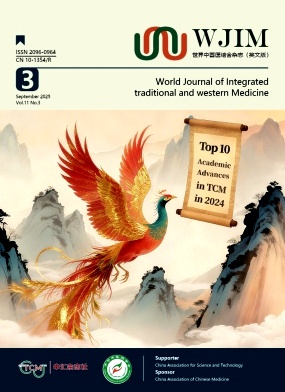
World Journal of Integrated traditional and western Medicine (WJIM)
publishes original theoretical research, development and application of
novel technologies and methodologies, as well as breakthroughs in
clinical scientific inquiries by outstanding young scholars in the
fields of traditional Chinese medicine (TCM) and integrated traditional
and Western medicine. It highlights cutting-edge achievements from
high-level academic activities, such as strategic scientific project
planning, salons on TCM clinical advantage diseases, forums on TCM
innovations, and evidence-based research outcomes, fostering
interdisciplinary collaboration.
By
consolidating industry expertise and academic resources, the journal
features high-quality papers, including annual reviews of the Top 10
Advances in TCM, major scientific questions in TCM, and summaries of
landmark scientific achievements, driving high-quality development in
the field. Additionally, it reports clinically significant cases with
profound implications for global life sciences research, inspiring
original innovations in biomedical science worldwide.
2. Article Types
2.1 Perspective
Expert
opinion from one or more people (who may agree or disagree) on a
published work, current understanding/status of an area, or how practice
should be undertaken. Generally with references.
3,000~12,000 words, 2~6 figures and/or tables
2.2 Review Article
Overview of developments in fields or the current lines of thought.
Synthesizes multiple sources of information.
Emphasis is more factual and less on opinion.
8,000~12,000 words, 2~6figures and/or tables.
2.3 Research Article
Reports of new research findings or conceptual analyses that make a significant contribution to knowledge
6,000 ~ 8,000 words and 6~8 figures.
Supplement file is no limit.
Including
Title, Abstract, Introduction, Methods and Materials, Results,
Discussion, Conclusions, Acknowledgments and References. We ask you to
provide editable source files for your entire submission (including
figures, tables and text graphics). Some guidelines:
Save
files in an editable format, using the extension .doc/.docx for Word
files and .tex for LaTeX files. A PDF is not an acceptable source file.
Remove
any strike through and underlined text from your manuscript, unless it
has scientific significance related to your article.
2.4 Case Reports
New,
interesting and rare cases can be reported. They should be unique,
describing a great diagnostic or therapeutic challenge and providing a
learning point for the readers. Cases with clinical significance or
implications will be given priority. These communications could be of up
to 3,000 words (excluding Abstract and references) and should have the
following headings: Abstract (unstructured), Keywords, Introduction,
Case report, Discussion, Reference, Tables and Legends in that order.
All the components that are required in Abstract(unstructured) based on
the reporting guidelines (CARE).
1,000~3,000 words, 2~6 figures and/or tables.
2.5 Commentary
1,500~2,000words and 1~2 figures, 15~20 references.
Type
Text Word Guideline
Abstract Word Guideline
Figure/Table Guideline
Reference Guideline
Perspective
should be undertaken. 3,000~12,000 words
No more than 400 words,unstructured. Graphical Abstract is also needed
2~6 figures and/or tables
Generally with references
Review Article
Emphasis is more factual and less on opinion,
8,000~12,000 words
No more than 400 words, unstructured. Graphical Abstract is also needed
2~6 figures and/or tables.
Research Article
Reports of new research findings or conceptual analyses that make a significant contribution to knowledge, 6,000~8,000 words
No more than 400 words, structured into: Background, Objectives, Methods, Results and Conclusions. Graphical Abstract is also needed
6~8 figures and/or tables
Numbered
consecutively, in the order in which they are cited in the text, and
should be formatted in WJIM style, more information on References Format
Case Report
New, interesting and rare cases can be reported, 1,000~3,000 words
No more than 400 words, unstructured
As above. The number of references should be no more than 10
Commentary
should be undertaken. 1,500~2,000words
No abstract
1~2 figures
15~20 references
3. Manuscript Preparation and Formatting Instructions
Manuscripts
must be written in clear, grammatical English. Manuscripts not
conforming to Journal format will be returned to authors for
modification. Please double space the entire main body document and
number each page.
Original Research Articles should include the sections listed below.
Title Page
Abstract
Keywords
Graphical abstract
Introduction
Methods
Results
Discussions
Conclusions
Acknowledgments
Statement of Ethics
Conflict of Interest Statement
Funding Source
Data Availability Statement
Author Contributions
References
Figures
Tables
Supplementary Material
3.1 Title page
You are required to include the following details in the title page information:
Article
title. Article title should be concise and informative. Please avoid
abbreviations and formulae, where possible, unless they are established
and widely understood, e.g., DNA).
Author
names. Provide the given name(s) and family name(s) of each author. The
order of authors should match the order in the submission system.
Carefully check that all names are accurately spelled. If needed, you
can add your name between parentheses in your own script after the
English transliteration.
Affiliations.
Add affiliation addresses, referring to where the work was carried out,
below the author names. Indicate affiliations using a lower-case
superscript letter immediately after the author's name and in front of
the corresponding address. Ensure that you provide the full postal
address of each affiliation, including the country name and, if
available, the email address of each author.
Corresponding
author. Clearly indicate who will handle correspondence for your
article at all stages of the refereeing and publication process and also
post-publication. This responsibility includes answering any future
queries about your results, data, methodology and materials. It is
important that the email address and contact details of your
corresponding author are kept up to date during the submission and
publication process.
3.2 Abstract
You
are required to provide a concise and factual abstract which does not
exceed 400 words. The abstract should briefly state the purpose of your
research, principal results and major conclusions. Some guidelines:
Abstracts must be able to stand alone as abstracts are often presented separately from the article.
No
more than 400 words, structured as follows: Background, Objectives,
Methods, Results and Conclusions. Graphical Abstract is also needed
Avoid references. If any are essential to include, ensure that you cite the author(s) and year(s).
Avoid
non-standard or uncommon abbreviations. If any are essential to
include, ensure they are defined within your abstract at first mention.
3.3 Keywords
are required to provide 3 to 5 keywords for indexing purposes. Keywords
should be written in English. Please try to avoid keywords consisting
of multiple words (using "and" or "of").
We recommend that you only use abbreviations in keywords if they are firmly established in the field.
3.4 Graphical abstract
You are required to provide a graphical abstract at submission.
The
graphical abstract should summarize the contents of your article in a
concise, pictorial form which is designed to capture the attention of a
wide readership. A graphical abstract will help draw more attention to
your online article and support readers in digesting your research. Some
guidelines:
· Submit your graphical abstract as a separate file in the online submission system.
·
Ensure the image is a minimum of 531 x 1328 pixels (h x w) or
proportionally more and is readable at a size of 5 x 13 cm using a
regular screen resolution of 96 dpi.
· Our preferred file types for graphical abstracts are TIFF, EPS, PDF or MS Office files.
3.5 Introduction
Describe
clearly the background to the research conducted and the specific
objectives. This should not be a comprehensive review of the literature,
however. State the specific objective or hypothesis of the study. Do
not include methods, data, results, or conclusions from the work being
reported.
3.6 Methods
Documentation
of methods and materials used should be sufficient to permit
replication of the research. Describe clearly the experimental design
including the control and experimental groups and provide eligibility
and exclusion criteria and details of randomization. Define all group
designations parenthetically at first mention [for example, "control
(CON) and high-fat (HF) groups"] and include definitions for these
abbreviations in the abbreviation footnote on the title page. Describe
the methods for, and success of, any masking (blinding) of observations.
Report any complications of experimental treatments.
State
the product name and manufacturer of specialized materials, diets,
chemicals, and instruments and other equipment, where appropriate.
Specify kits, analyzers, and commercial laboratories used. Identify
precisely all drugs and chemicals used, including generic names,
dosages, and routes of administration. If trade names for drugs and
chemicals are included, give the manufacturer's name and location. Do
not use trademark names, such as Teflon, as generic terms. Give
references for established methods, including statistical methods;
provide references and brief descriptions of methods that have been
published but are not well known; and describe new or substantially
modified methods, giving reasons for using them and evaluating their
limitations.
3.7 Results
Present
your results in a logical sequence in the text, tables, and figures. Do
not present specifics of data more than once and do not duplicate data
from tables or figures in the text. Do not present data from individual
subjects except for very compelling reasons. Report losses to
observation (such as dropouts from a clinical trial). Use boldface for
the first mention of each table or figure.
3.8 Discussions
Emphasize
concisely the important aspects of the study and the conclusions that
follow from them. Do not repeat in detail data or other material given
in the Introduction or Results. Include the implications of the findings
and their limitations and relate the observations to other relevant
studies. Link conclusions with the goals of the study and avoid
unqualified statements and conclusions that are not completely supported
by the data. Avoid claiming priority and alluding to work that has not
been completed. State new hypotheses and recommendations when warranted
by the results and label them clearly as such.
3.9 Acknowledgments
section normally includes sources of research funds, the names of
collaborators who are not listed as coauthors, or of any others who
contributed to the manuscript. Where a medical writer or editorial
assistant has been used to write or edit the article, the writer must be
identified and named, together with the source of funding.
3.10 Statement of Ethics
For
all manuscripts reporting data from studies involving human
participants or animals, formal review and approval, or formal review
and waiver, by an appropriate institutional review board or ethics
committee is required and should be described in the Methods section or
in this section. For those investigators
who do not have formal ethics review committees, the principles
outlined in the Declaration of Helsinki should be followed. For
investigations
of humans, state in the Methods section the manner in which informed
consent was obtained from the study participants (ie, oral or written)
and whether participants received a stipend. Authors of research studies
involving humans should not make independent determinations of
exemption or exclusion of IRB or ethical review; they should cite the
institutional or regulatory policy for that determination and indicate
if the data are de-identified and publicly available or protected by
prior consent or privacy safeguards. Editors may request that authors
provide documentation of the formal review and recommendation from the
institutional review board or ethics committee responsible for oversight
of the study. If there is no Ethical Approval of Studies and Informed
Consent, please indicate, "Not applicable – Not required for this
study."
......
更多详见:
https://www.tcmjc.com/wjim/authorCenter?scroll=section_1