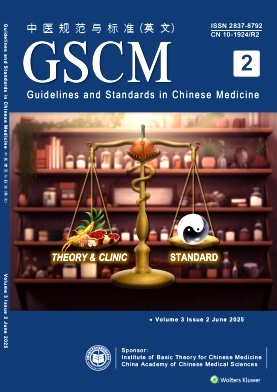
高频栏目
审稿时间:暂无参考数据,审稿时间不确定!
见刊周期:-
温馨提示:以上只是参考信息,实际情况会根据投稿主题、稿件质量和数量、审稿流程有所差异。想获得更准确信息请联系期刊的编辑部进行咨询。
万维提示:
1、投稿方式:在线投稿。
2、刊内网址(202502期):
https://journals.lww.com/gscm/pages/default.aspx
3、投稿系统:
https://www2.cloud.editorialmanager.com/gscm/default2.aspx
4、刊内电话:010-64089043
5、刊内邮箱:GSCM2023@126.com
6、出刊日期:季刊,逢季末月出版。
7、官方微信公众号:中医规范与标准
8、官网信息:不收版面费审稿费。
2025年7月17日星期四
Instructions For Author
【官网信息】
The
Editorial Office is pleased to answer any questions you may have about
preparing your manuscript in accordance with our guidelines.
Email: GSCM2023@126.com
AIMS AND SCOPE
Guidelines
and Standards in Chinese Medicine (GSCM) is an international open
access journal publishing peer-reviewed papers focusing on guidelines
and standards-related studies of Chinese medicine, herbal medicine,
acupuncture, moxibustion, homeopathy, complementary and integrative
medicine, and others.
We particularly welcome studies including but not limited to:
Development
and application of clinical practice guidelines, experts consensus,
international/ national/ industry/ group/ standards;
Quality
assessment of published clinical practice guidelines, experts
consensus, international/ national/ industry/ group/ standards;
New tools/ methods/ methodological issues related to guidelines, consensus or standards;
We also welcome studies that could promote the development and application of guidelines and standards:
Design
protocol, statistical analysis and reporting of clinical researches
(randomized/ non-randomized controlled trials/ cohorts/ case-control
studies/ case series/ case reports)
Basic
science research using modern technology and method to explore the
mechanism of the disease based on Chinese medicine, complementary and
integrative medicine hypothesis and theory;
Pharmacy
and pharmacology researches with focus on processing, extraction,
identification and others to promote the innovation, modernization and
application of herbal medicine;
Interdisciplinary studies, such as evidence-based public health policy and practice, medical-industrial crossover research.
We
now publish original research and review papers. We may also publish
opinion, perspective, letter to editors or short communications which
are by invitation only.
ONLINE SUBMISSION
All manuscripts must be submitted online at: https://www.editorialmanager.com/GSCM/default2.aspx.
First-time users
Please
click the Register button at
https://www.editorialmanager.com/GSCM/default2.aspx. Upon successful
registration, you will be sent an email providing your username and
password. Save this information for future reference. Note: If you have
received an email from us with an assigned username and password, or if
you are a repeat user, do not register again. Once you have an assigned
username and password, you do not have to re-register.
Authors
click the Login button from the menu at the top of the page and login
to the system as an author. Submit your manuscript according to the
author instructions. You will be able to track the process of your
manuscript through the system.
JOURNAL POLICIES
DUPLICATE PUBLICATION
Manuscripts
are reviewed for possible publication with the understanding that they
are being submitted only to the Guidelines and Standards in Chinese
Medicine and have not been published, simultaneously submitted, or
already accepted for publication elsewhere. The Editorial team may
subject any manuscript submitted for consideration of publication in
Guidelines and Standards in Chinese Medicine to plagiarism-detection
software.
This
does not preclude consideration of a manuscript that has been rejected
by another journal or a complete report that follows publication of
preliminary findings elsewhere, usually in the form of an abstract.
Copies of any possibly duplicate published material should be submitted
with the manuscript under consideration, with a statement in the cover
letter as to why the manuscript currently being submitted is not a
duplicate publication.
DISCLOSURE OF CONFLICTS
must state all possible conflicts of interest in the manuscript,
including financial, consultant, institutional and other relationships
that might lead to bias or a conflict of interest. If there is no
conflict of interest, this should also be explicitly stated as none
declared. All sources of funding should be acknowledged in the
manuscript.
All
relevant conflicts of interest and sources of funding should be
included on the title page of the manuscript with the heading "Conflicts
of Interest” and “Source of Funding".
For
example: “Conflicts of Interest: A has received honoraria from Company
Z. B is currently receiving a grant (#12345) from Organization Y, and is
on the speaker's bureau for Organization X - the CME organizers for
Company A. For the remaining authors none were declared.”
“Source of Funding”: list all the grant supports/funders for the study.
A
financial disclosure section is part of the submission process and must
be completed by each author at first revision. This information is for
review by the Editors but will be published if relevant to the content
of the accepted manuscript.
primary purpose of the disclosure section is to determine whether
authors have received any commercial financial support that could create
a conflict of interest. In addition to monetary interests, a potential
for conflict of interest can exist whether or not an individual
believes that a relationship (such as dual commitments, competing
interests, or competing loyalties) affects his or her scientific
judgment. Please review ICMJE Uniform Requirements for Manuscripts
Submitted to Biomedical Journals at the following link:
http://www.icmje.org/conflicts-of-interest.
Studies in humans and animals
If
the work involves the use of human subjects, the author should ensure
that the work described has been carried out in accordance with The Code
of Ethics of the World Medical Association (Declaration of Helsinki)
for experiments involving humans. The manuscript should be in line with
the Recommendations for the Conduct, Reporting, Editing and Publication
of Scholarly Work in Medical Journals and aim for the inclusion of
representative human populations (sex, age and ethnicity) as per those
recommendations. The terms sex and gender should be used correctly.
should include a statement in the manuscript that informed consent was
obtained for experimentation with human subjects. The privacy rights of
human subjects must always be observed.
animal experiments should comply with the ARRIVE guidelines and should
be carried out in accordance with the U.K. Animals (Scientific
Procedures) Act, 1986 and associated guidelines, EU Directive 2010/63/EU
for animal experiments, or the National Institutes of Health guide for
the care and use of Laboratory animals (NIH Publications No. 8023,
revised 1978) and the authors should clearly indicate in the manuscript
that such guidelines have been followed. The sex of animals must be
indicated, and where appropriate, the influence (or association) of sex
on the results of the study.
describing studies involving animals must have consulted the ‘Animal
Research: Reporting In Vivo Experiments’ (ARRIVE) 2.0 guidelines,
developed by the NC3Rs to improve standards of reporting, ensuring that
the data from animal experiments can be fully scrutinized and utilized.
Articles reporting in vivo experiments must adhere to the ARRIVE Essential
10 checklist as a minimum, and we encourage authors to use the full
ARRIVE 2.0 checklist. The relevant information outlined in these
guidelines should be included in the appropriate section of the article.
...
更多详见:
https://journals.lww.com/gscm/Pages/Information-to-Authors.aspx